Wiring For High Speed Ethernet March 5, 2009 1

Lets face it, wireless just isn’t going to cut it for a large house with many computers and devices on it. I still to this day have friends asking me why hardwire anymore? Some of them adamantly oppose my preference for copper for reasons unbeknownst to me. Being a software engineer and avid geek I have a great deal of experience with enterprise systems. Although all companies structure their data centers differently there is one thing they all have in common, copper. In order to hit high speeds reliably you must have a direct connection the switch or router. A house with many devices is no different.
Here is a perfect example of why I am hard wiring as many things as I can, leaving the wireless to just the peripherals. My housemate and I stream music wirelessly to other rooms from one central machine. The music is stored on the network via NAS (network attached storage). When we are playing music from our main iTunes machine, the music must be pulled from the NAS via wifi to the machine, then back out to the wireless access point, then out to its final destination. That is a lot of network hops over the airwaves! Now start adding other devices like iPhones or laptops and your music starts skipping and some devices start getting kicked off the network. The problem multiplies when you are streaming video from room to room and doing multiple things at one time. Its an all around bad scene and an annoyance. Enter gigabit ethernet via Cat 6!
Switching to this system we have permanently eliminated this issue, creating speeds that are literally 10 times faster than even 802.11n. In my experience, N is not that fast and progressively gets worse the farther you travel from your access point. Then add 10 other hungry devices on the same access point and your out of luck. Reliability is gone. Hardwiring as many devices as you can frees up your WiFi for the devices that actually need them, PDA’s and laptops.
So, now I have hopefully explained myself enough, onto the actual work! I am not going to give a tutorial on how to run wires, just point out a few tips and tricks I encountered along the way. First and foremost, run more wires than you need! You never know what the future holds and how technology is going to change. Now a days you can run everything from video to home phone over Ethernet cable.
Second, and almost as important as the first, any open wall is an opportunity! Case in point, the new fireplaces that are being installed gave me ample room to run two new pieces of Cat 6 to the living room.
In other cases, I have also run cabling outside along with the coax cable for television. That being said, Ethernet cable does not like the sun and will crack over time. Water should be okay but time will tell. At least its not buried in a wall that I will never want to open again.
To make the installation look neat and professional go down to the Home Depot and get yourself some nice wall plates and Ethernet jacks from Leviton. They aren’t too expensive and give a nice finished look. They are also easy to install and directions come with every port, along with a little tool that helps you punch the wires down tight. One thing the directions don’t tell you is which wiring schema to use! This confused more for a second there until I realized on the back of the port you could peel off the T568B wiring layout to reveal the T568A layout. See the picture below.
Other than that there were really no surprises. The job went quite quickly and the results were immediate. My favorite type of results! Our network is blazingly fast, more reliable, and our access point seems to be happier and faster because of it. Thank you good old copper!
Install a Flat Panel TV with Hidden Wiring March 4, 2009 3
We all love the look of a nice sleek flat panel TV on the wall but no one likes the look of the wires just dangling there. Hiding them is actually quite simple it just takes a little thought a few tools. My job was little more complicated because I had to figure out how to keep them away from the chimney but the principal is the same anywhere. This is a great thing to try on your own as its a pretty simple job. Worse comes to worse, you pay someone to finish the job if you cant complete it yourself.
Really all you have to do is make holes around the studs so that you can pass wires over them. If your walls are lath and plaster like mine its a little hard to use an electronic stud finder but its still possible. I just knock and listen like the old timers do. Once I find the studs, I knock out rectangles over them so I can run my wiring there. I also like to notch out the studs and then put nail guards over them so a future owner wont put a picture frame nail through them. You could also drill through the studs but HDMI cable heads are kinda big, as well as all the other wires you gotta pass through there.
Make sure that you properly pin down the wires so that they dont get yanked out accidentally. You can use a nail guard like I did or staples. Just be sure not to crimp the wires! I would hate to have to do that twice. Now that the hard part is done, its time to get out the plaster and close up the holes that you made.
I also went the extra step and ran power to the TV so that I could use my power conditioner. I highly recommend using a nice conditioner like a Furman or Panamax to protect your equipment. Being paranoid and not liking to do things twice, I ran this power separately from the other video cables so as not introduce any interference. Again, I hate doing things twice.
Behind the TV I installed a two-gang junction box and a special flat panel TV box that is recessed to give you more room. I picked both of these things up at the Home Depot for a few dollars. Be sure to check out the back of your TV and decide where the box should go. Some places have more room than others and every TV is made differently.
Now if you want to get really fancy like I did, I installed nice wall plates behind my stereo setup for a professional finished look. You can easily just dangle them out from behind the drywall but who wants to do that? If you’ve come this far you may as well go the whole way.
I picked up wall plates for my component video, HDMI, and speaker cable from hififorless.com, one of my favorite cheap equipment suppliers. They didnt cost much and the installation is self explanatory. When it said it done, it looks quite nice. To the right is the component video and HDMI plate I installed from SCP Wire company.
All in all, this is pretty simple task that the average do-it-yourselfer can handle. As I said before, its a great one to try for your first time as its simple to repair if you make a mistake. I would hate to throw away a few hundreds dollars when this job can easily be tackled. A flat panel TV costs enough, save your money!
For more picture visit this flickr set.
Gas Inserts for the Old Fireplaces February 27, 2009 5
Like many of the old houses I come across here in San Francisco, the fireplaces are non functional. This is due to a number of reasons. Lack of upkeep which leads to safety issues, bad landlords or past owners, or disinterest in dealing with San Francisco’s Spare the Air days. For those of you not in the know, if you have a wood burning fireplace and you use it during a Spare the Air day, you can get fined. This means you must turn on the news or go online to find if you can use your fireplace.
Anyway, when we moved into our place all three of the fireplaces were not working. We are still unsure of how original they are but when I find out I’ll provide updates. What I do know is that there was only one original fireplace as there is only one real brick chimney. At the time it burned coal. The other two, the top parlor and bottom parlor, were just framed in “bump outs” with vents in them. The strange thing is, the bottom parlor only had a vent and no gas line at all, but the top parlor had both.
The two wood mantle and tile fireplaces we are keeping as they are very old and are very fitting of the time period regardless of their originality to the house. Those are in the front parlor and guest room, which was at one point the dining room? The white one you see is a craftsman style brick that resides in the top parlor. That’s the one we demolished and are having replaced with a Carrera marble mantle and gas insert. They should be completed in the next few weeks and I’ll update as that happens.
Newer posts regarding the fireplaces:
Replacing Old Knob and Tube Wiring February 23, 2009 1
If your house is over 50 years old like mine is, chances are you have knob and tube wiring somewhere. Although its pretty cool to look at it and a marvel of its time, its outdated, annoying to work with, and most importantly ungrounded. Many electricians will tell you to leave it and I would agree; however, my home automation needs updated wiring to work. So, we began the daunting task of deprecating old wiring on a case by case basis.
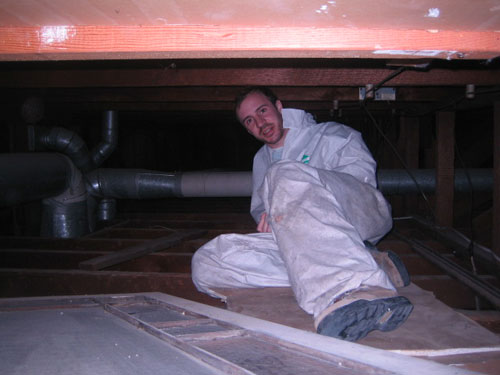
Luckily, I have crawlspace access above the second story which is our main living space. That being said, its tight an cramped, not too mention 12 feet up through a skylight. Not the easiest thing to get into. When I got up there though, I was surprised at the cleanliness of it all. No animal remains at all and everything appeared to be in good order, except for the wiring! Yikes! It had been hacked and spliced over the years to the point where some of it was unsafe. As you can see from the picture above, I found new romex wiring spliced into knob and tube wiring that was abandoned. So I began the process of cutting out the old wiring and replacing it with the new. We still have some left but I like to think its a little safer now.
Wiring is actually quite simple and there’s really not much to know. The trick is, check your work and try to minimize the damage you make existing walls. Lets take the picture you see below as an example:
For some reason, the dining room had no chandelier. Luckily, I had clean grounded power in an outlet by the door from when the kitchen was redone. So, I made a hole in the plywood above the outlet for the new light switch. I was going to simply run a wire from the outlet to the switch into the ceiling but of course, this being an old house, there was crossblocking everywhere. Normally I would just find the block and open up a hole there to pass the wire through but this was all finished wood, not plaster. Instead, I opted to go through the kitchen and make holes there up to the ceiling rather than ruin all the finished work.
In the picture below you can see how I ran the new wiring through the blocking. I made the hole slightly larger than it had to be for a number of reasons. The first is to get a long bit in there to drill through the blocking. You can also chisel out a piece of the blocking and run the wire through that but just be sure to cover it with a nail guard so someone doesn’t try and put a picture hanger through it at a later date. The second reason for the bigger hole is so that I have something to support the new piece of drywall that I will have to put in there.

More photos can be found here.
Make Your Own Chandlier November 22, 2008 0
This was posted on my personal blog here and later on Apartment Therapy here.
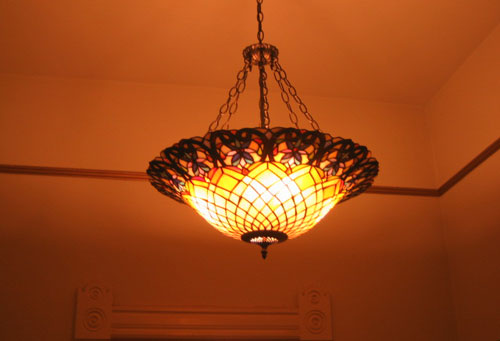
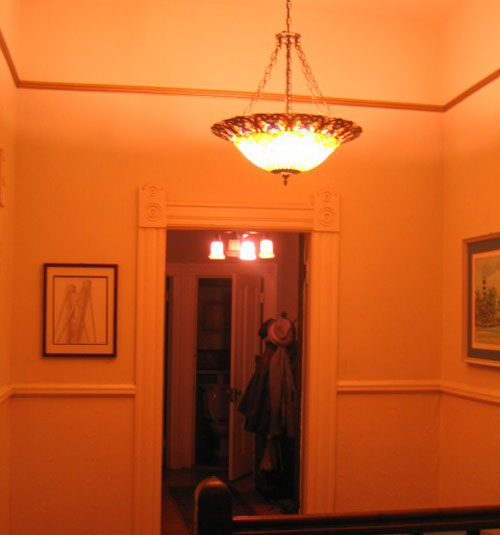
When my housemate and I moved into our new place we weren’t thrilled with the victorian-style knockoff chandelier that was in our living room. Our friend recommended we paint it and see if we still wanted to throw it out. So, I took the idea and ran with it. Needless to say, it’s definitely not getting thrown out any time soon. Here is a picture of the finished product.
This was a pretty simple project and started out with a beat up old chandelier. I took it down and cleaned it off as best I could with soap and water. Then I sprayed it with some white primer before hitting it with two coats of high gloss orange. That was the easy part and didnt take too long.
Next I had to track down some small lamp shade covers. I came across a nice set of 8 at lampsplus.com. First thing I did when I got them was template. This was crucial in cutting out 5 copies from the fabric. I simply wrapped a big enough piece of paper around the lamp shade and taped it. Then I trimmed up all the excess and unwrapped it. Voila template.
After all of the fabric was cut out it was time to warm up the glue gun. Make sure to try and line up the fabric seam with the seam thats already on the lamp shade. First I glued one side down where I wanted it, then I would take out all the slack and wrinkles and fold the over the other side. Dont worry about making this perfect. Once you fold over the top and button around the lamp shade rim you can deal with the rest of the slack.
And thats it! There’s not much to it and it didnt take long. I was able to save an old chandelier from the dump and go something completely original in return. There are more pictures up on Flickr including one of the completed room.
Top Parlor Gets Color November 2, 2008 0
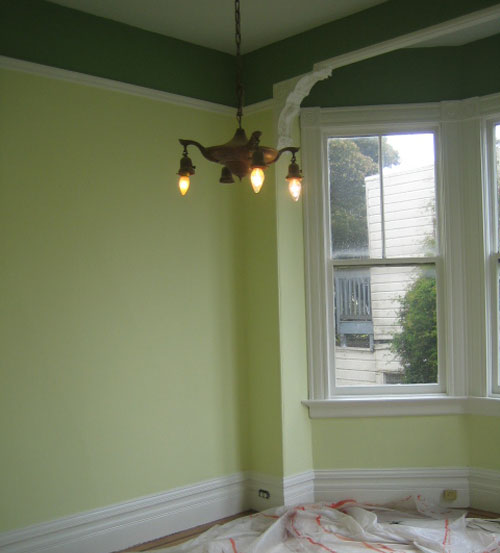
Although there is much more work to do on the top parlor, we have finally decided on color choices. I think it has turned out quite well, sans the brown molding. We chose Behr’s ‘Garden Path’ for the top portion and Benjamin Moore’s ‘Weston Flax’ for rest. A lot more updates are on the way including swatches, furniture, and painting the hideous brown colored molding. For now this will have to do. Oh yea, and don’t mind those holes either. That’s where we are wiring up our sound system and television.
To see all the pictures for this project click here.
Updating the Craftsman Dining Room October 28, 2008 0
When we moved in, we immediately started figuring out our order operations; what was most important to us. It turned out to be a nice living area, a place to eat, and a kitchen. That being said, our kitchen was done, we had a temporary living room downstairs, so it was off to the dining room. My housemate loves to cook and I love to entertain so the dining room seemed to be a logical choice.
What a choice that turned out to be! At first glance, we thought we may keep the wood as is, just sand and refinish. Upon further inspection, the wood was cheap plywood and it had been glazed over numerous times. Even if we wanted to refinish it, that cheap plywood would still show through. So, we decided to paint.
After days and days of sanding and scraping off the old glaze it was finally time for a primer. We went with an oil based primer to bond with the oil based glaze that we had scuffed and sanded to create mechanical bond. That in itself was a daunting task. The stuff goes on thick but it was worth it. After a thick coat of primer applied a latex final coat of white. Well, three coats to be exact. We really wanted a deep rich white and that’s what it takes. Many many coats.
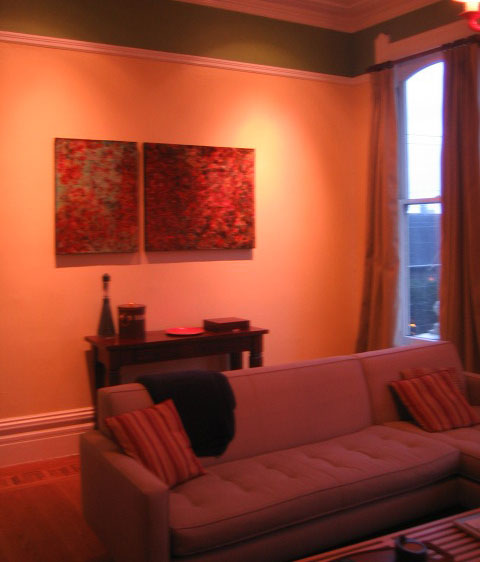
The same holds true for the wall color that we chose. It is Behr’s “Old Flame”. It came out beautifully but took numerous coats. If out anyone knows anything about painting red it can be a royal pain. If you’re going to embark on this journey, don’t lie to yourself. It will take a minimum of three coats end of story. Brace yourself. In our case, it took four! But as you can from the results, its totally worth it.
Seismic Retrofitting Begins October 10, 2008 4
Although this house has stood proudly on the hill for over 120 years in a seismically active part of the world, its still in our best interest to shore up the foundation. Luckily for us, this house held up through the big 1906 earthquake as well as the one in 1989 due to the fact that is built on solid bedrock. Its quite remarkable considering the foundation is made of brick and mortar and the house is held to it with gravity alone. After all is said and done, this house should stand for at least a hundred more years.
In order to update our aging foundation, we are doing what the experts call a “cap and raise”. That means they are going to raise the sill plate that currently sits on the brick, drill holes for large bolts to attach to the sill, epoxy rebar into drilled holes in the bricks, and encase the whole thing in high strength concrete. If you click on the picture to your right, you should be able to see a closeup of what is actually going on here. In addition, we are having two large steel girders put in to help support the front of the house in place of an old wood beam and turnbuckle system. How this house held up so long is quite incredible.
For more photos on this project click here.
Refinishing the Floors September 28, 2008 0
This is not a job for faint of heart which is why we opted for this job to be done by the professionals. One might think to themselves, “hey I can sand, why not do them myself?”. Wrong! If you’re refinishing one small room, maybe. Even then, it will take you at least a weekend with some trial and error not to mention tool rentals and back breaking work. This is not something you want to attempt with a Craftsman belt sander and a few friends.
Do what we did and hire an expert. In this case, we called Jesus Estrada, owner and operator of Architectural Floors. Him and his crew were in an out in less than a week and thats doing over 2,000 square feet! They paid close attention to all the little nuances of our 120 year old floors. Our floors are not tongue and grove but flat white oak nailed right to the subfloor. Also, each room has decorative inlay, some are very intricate and some are simple bands of cherry around the room.
In any case, Jesus and his crew reset every single nail in the entire house, sanded all the floors down, completely puttied them, and sanded again. Then, and only then could they put on a coat of chestnut stain and three coats of varnish. This was no small job and we are quite happy with the results.
See more photos of the floors here.
Let the Restoration Begin! September 16, 2008 3

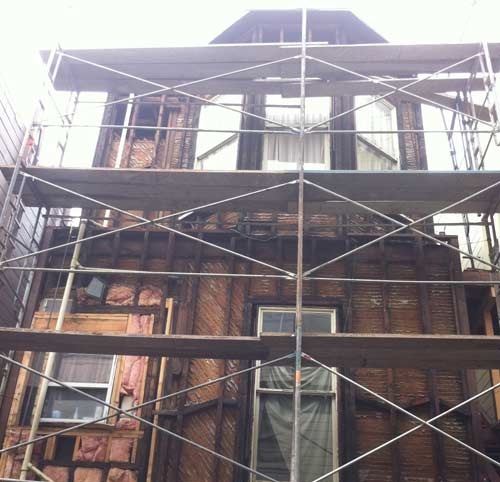
The project is an 1890 San Francisco Victorian house. Over the years it has been through a lot. Its seen two massive earthquakes, a series of negligent owners, and a whole lot of ugly wallpaper but its still standing. Luckily, my housemate and I are here to restore it to its original grandeur with some updated amenities as well.
When we got it, it had recently been converted back into a one family home as it was originally intended. At some point along the way, it was converted into to separate units and a lot of that can still be seen all over the house. For example, the kitchen is on the second floor! The previous owner decided to remodel it there rather than bring it back downstairs but thats another story for another post. There are also still two gas meters as well as two electrical boxes. Its going to take a lot of work to bring it back to its original glory but we’re up to the task.
Hopefully over the years we will be able to discover more about the house’s history but its going to be a challenge. After the 1906 earthquake a massive fire ensued and burned almost all the records of the home. The only records that remained were the water records which were stored in another location. Thats the only thing linking this house to the year it was built, 1890. So stay tuned as we document the houses history, renovation, and hopefully its rich history though all the years its been sitting on this hill.
See the photos from the open house here